

Dust doubles self-serve customers and mitigates LLM token abuse with Persona's Phone Risk Report
Learn how Dust used Persona to prevent free-trial abuse and resume self-serve signups without requiring a credit card.
Dust is an enterprise AI platform that lets organizations build, customize, and deploy team-specific AI agents. When Dust launched in 2023, it offered a free trial that anyone could sign up for without a credit card. The idea was to attract users who would then invite coworkers and, ultimately, become paying customers. But it also attracted bad actors.
Problem: Dust wanted to offer a free trial, but it attracted fraudsters
Henry Fontanier is one of Dust’s founding engineers, and he remembers the early days clearly.
“Very quickly, the free trial got abused by a ton of people,” Henry says. “We found Discord servers where people were sharing tips about how to create unlimited accounts on Dust. We were also concerned that people would try to use Dust to access models they weren’t allowed to use in their countries.”
The free trial led to so many fake accounts that Dust shut it down temporarily. When the team decided to relaunch a free trial offering later, they required a valid credit card to help deter bad actors. But many people were reluctant to enter their credit card details, leading to a 60% drop-off at sign-up.
“People clicked through when we promoted the free trial, but our conversion rate was a lot lower once we started asking for a credit card,” Henry says.
Dust wanted to attract self-serve customers, including smaller startups and individual users, by letting them try the product without a credit card. But first, it needed a low-friction way to deter bad actors who wanted to exploit the free trial for AI tokens.
Solution: Dust uses insights from Persona to launch a frictionless free trial
Dust knew it had to introduce new controls to detect bad actors, and it considered a few approaches.
Validating or scoring email addresses was an option, but it wouldn’t be a strong enough deterrent. “When you have a free trial that includes AI tokens, it’s pretty valuable,” Henry says. “We needed an option that offers robust risk signals.”
But going too far in the opposite direction, such as asking for a government ID or running a full KYC flow, would introduce too much friction.
Dust settled on evaluating risk based on the user’s phone number as the best option, and it chose Persona for several reasons:
Clear documentation and in-depth results
“We looked at Persona’s docs, and everything felt super clear,” Henry says. “And when we tried the API, the results were super, super detailed.”
Persona’s Phone Risk Report assesses the fraud risk of a phone number. It also delivers a risk level (1 to 5), risk score (0 to 100), and risk recommendation (allow, flag, or block).
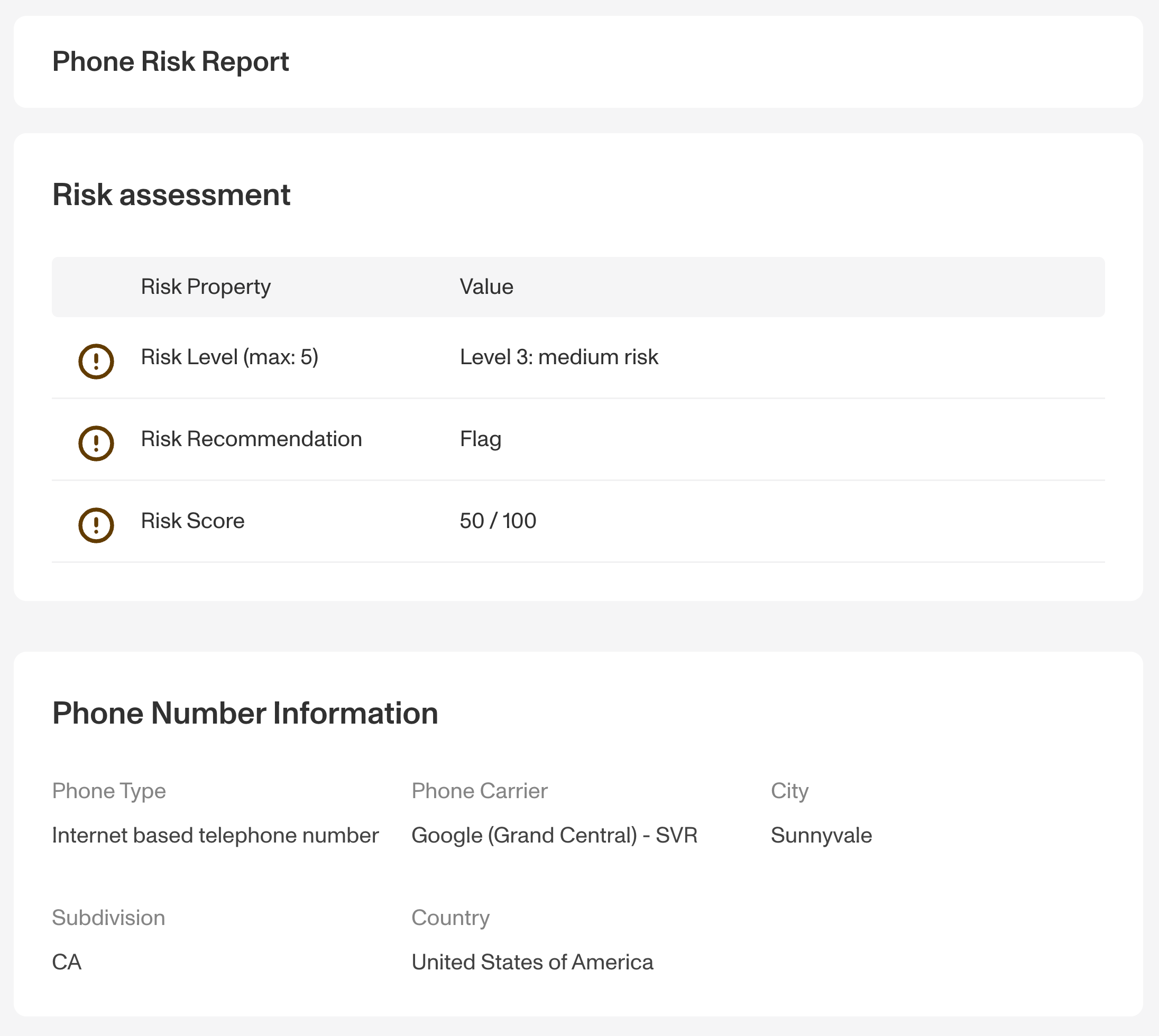
“We realized it was probably the best tool to score a phone number,” Henry says.
The report is available for phone numbers globally and can tell you which phone carrier and which of the 12 possible phone types the number is associated with, including mobile, prepaid, VoIP, and fixed line.
“The single most valuable part of the report for us is the risk recommendation,” Henry says. “When we send a phone number, Persona replies with a block, flag, or allow recommendation. Basically, every legitimate phone number falls into allow.”
Organizations should be wary of false positives when adding any type of verification check because flagging or blocking legitimate users is bad for business. But Henry is confident in Persona’s results and says Dust rarely receives complaints.
Rapid deployment that doesn’t require ongoing support
The Dust team was also impressed by how easy it was to get Persona up and running.
Integrating a new solution can sometimes be a big lift, but after an initial conversation with Persona about the Reports API, the Dust team quickly created a test environment and then pushed everything to production.
“The whole integration took about a day,” Henry says. “We’ve barely had to touch it since. It’s just working perfectly.”
Results: Dust doubles its growth while maintaining robust fraud controls
With Persona’s Phone Risk Report in place, Dust can quickly assess the risk associated with a new user’s phone number and decide whether to grant them access to the free trial.
“Once we began using Persona, we doubled our signups and kept the same conversion rate for self-serve customers,” Henry says. “Almost twice the number of people ended up as paying customers, so it was a great success.”
Dust is also exploring new products and features, including public-facing, unauthenticated AI agents that can be embedded on customers’ websites or shared via front-end apps. These would allow people who haven’t logged in to Dust to chat with the agent.
“As new use cases come up, we’ll definitely look at using Phone Risk Reports and other Persona products,” Henry says. “Persona is the best way to figure out if someone is a human online.”