
What is KYC verification? An overview




KYC verification is the process of verifying a customer’s identity to assess risk, comply with regulations, and prevent fraud. Short for “Know your customer”, KYC is a legal requirement in many industries, including financial services, where identity fraud and money laundering are major concerns.
Failing to get KYC right doesn’t just create risk — it leads to real penalties. According to Corlytics, global anti-money laundering (AML) financial penalties reached $2.91 billion in Q2 2025 alone — a 193% increase from the previous quarter. Many of these fines stemmed from weak compliance controls, especially around cryptocurrency and sanctions violations.
In this guide, we break down what KYC verification is, the main verification methods, key challenges teams face, and how to select the right technology for compliance.
What are the key components of the KYC verification process?
The key components of the KYC process are: customer identification program, customer due diligence, and ongoing monitoring. Together, these frameworks support secure onboarding and long-term relationship monitoring.
1. Customer identification program (CIP)
The customer identification program (CIP) is the initial step in the KYC verification process, focusing on collecting and verifying basic customer information to establish their identity. Regulated industries are required to obtain the customer’s:
Full name: As it appears on official documents
Date of birth: To confirm the customer’s age and identity
Address: Current residential address for correspondence and verification
Identification number: Such as a Social Security Number or passport number
These details are typically verified using government-issued identification documents like passports or driver’s licenses. The CIP is mandated under regulations such as the USA PATRIOT Act, which requires financial institutions to implement procedures for verifying the identity of individuals opening accounts.
2. Customer due diligence (CDD)
Following identity verification, customer due diligence (CDD) involves assessing the customer’s risk profile to prevent financial crimes like money laundering and terrorist financing. This process includes:
Risk assessment: Evaluating factors such as the customer’s occupation, financial history, and geographic location to determine their risk level.
Enhanced due diligence: For high-risk customers, conducting deeper investigations into their financial activities and background.
CDD is a cornerstone of anti-money laundering compliance, ensuring that financial institutions understand their customers’ activities and the potential risks they pose.
Keep learning: Know Your Customer (KYC) vs. Customer Due Diligence (CDD)
3. Ongoing monitoring
Ongoing monitoring is a continuous process where financial institutions track customer transactions and behaviors to detect and report suspicious activities. Key aspects include:
Transaction monitoring: Analyzing financial activities in real time to identify unusual patterns or behaviors.
Periodic reviews: Regularly updating customer information and risk assessments to reflect any changes in their profile.
Keep learning: Perpetual KYC: The future of customer due diligence
What are the main KYC identity verification methods?
KYC verification has come a long way from paper forms and in-person inspections. What started as a manual, document-based process has evolved into a range of digital methods designed to meet the growing demands of security, scale, and speed.
The main KYC identity verification methods include:
Manual verification
Manual verification involves the physical inspection of identity documents by trained personnel. This traditional approach requires customers to present original documents, such as passports or driver’s licenses, in person. This method offers strong assurance but is resource-intensive and often slows down onboarding.
Electronic KYC (eKYC)
eKYC uses digital technologies to verify identities remotely, streamlining customer onboarding. This method often involves document scanning, selfie verification, and database checks.
By leveraging eKYC, businesses can reduce onboarding friction for customers while verifying identities at scale. This method is often implemented as mobile KYC to make onboarding even faster and more accessible.
A growing number of businesses turn to platforms like Persona to simplify and customize their eKYC and mobile KYC processes. Persona enables organizations to verify identities at scale while adapting flows to regional regulations and customer expectations, reducing AML/KYC compliance risk without compromising on user experience.
Hardware-based verification
Hardware-based verification employs built-in device features, such as Touch ID or Face ID, to authenticate users. Because this method depends on built-in device features, its role in Know Your Customer programs may be limited by customer access to compatible technology.
API-based verification
API-based verification integrates third-party verification services into business platforms, automating the KYC verification process. These APIs connect to various data sources to validate customer information.
We created this table to help you understand how each KYC identity verification method compares.
| KYC verification method | Accuracy | User experience | Regulatory fit | Fraud risk |
| Manual verification | High accuracy, as trained staff can detect forgeries | Time-consuming and requires a physical presence | This method meets compliance standards but lacks scalability | There is a lower risk of fraud due to direct inspection, but it is prone to human error |
| eKYC | Highly accurate, leveraging AI to detect fraud | Fast and convenient remote verification experience | eKYC complies with digital standards and is adaptable | Compliance teams reduce fraud risk through algorithms and real-time data analysis |
| Hardware-based | Highly accurate, using device-specific data | The experience is seamless and quick for users | Regulatory fit varies by jurisdiction and may require other methods | Fraud risk is low, as this data is difficult to replicate |
| API-based | Highly accurate, accessing multiple databases | The process is efficient and requires minimal user input | Flexible and can be customized for specific requirements | Reduced through continuous updates from data sources |
The major challenges in KYC identity verification today — and how Persona helps
Establishing a proper KYC identity verification process has become a pressure point for compliance leaders. You’re expected to stop fraud without slowing growth, stay ahead of regulatory changes across jurisdictions, and keep customer onboarding fast and frictionless. But the job keeps getting harder. Fraudsters move faster, regulations shift, and users won’t wait. Legacy systems don’t keep up.
Here are the top four Know Your Customer challenges for compliance leaders handling KYC verification today:
1. AI-generated deepfakes
The line between real and fake is getting harder to spot. Fraudsters are using AI to generate synthetic identities and hyper-realistic deepfakes — powerful enough to trick legacy IDV systems. It’s a growing concern across industries. Gartner predicts that by 2026, 30% of enterprises will no longer rely on identity verification or authentication methods in isolation because of the risks deepfakes pose.
This doesn’t mean identity verification is broken — it means it needs to evolve.
How Persona helps
At Persona, we’ve long anticipated this shift. Our approach aligns directly with Gartner’s recommendations for combating deepfakes. For example, we use:
Liveness detection, enhanced: We use both active and passive liveness techniques — from gesture tracking and eye movement to detecting inconsistencies in lighting, skin texture, and gaze direction — to catch deepfakes and screen replays.
Multi-signal verification by design: We don’t rely on a single signal like face match. Our system cross-checks a wide range of passive and active data, including device metadata, IP address, camera source, and user behavior. If one layer misses something, another catches it.
Threat monitoring that looks ahead: We proactively monitor AI forums, model releases, and underground threat channels to understand how attackers build and test deepfake models. This process gives us the context to respond before new fraud patterns go mainstream.
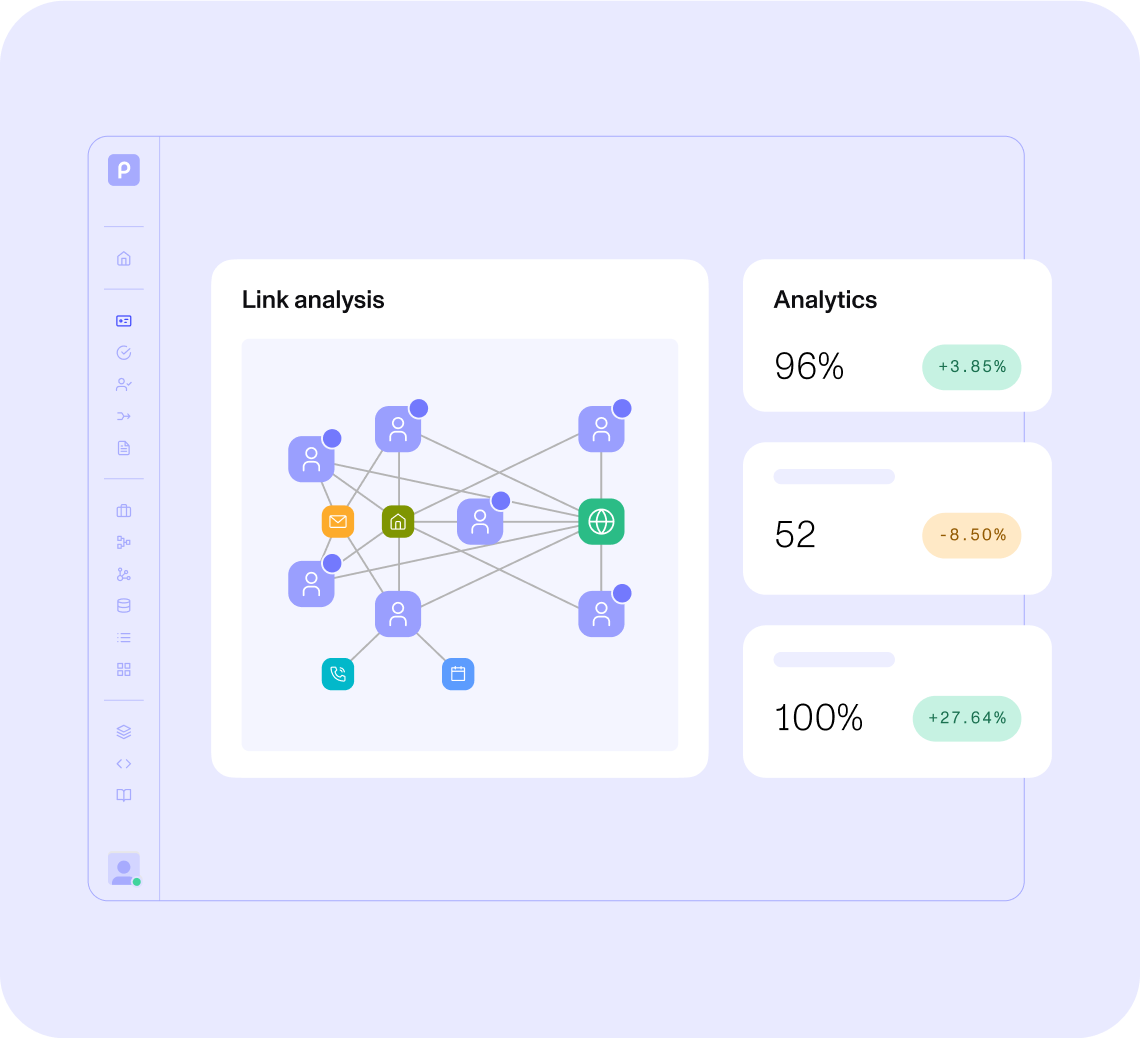
Graph-powered link analysis: Our Graph tool lets you see relationships between accounts and surface coordinated attacks fast — even if the individual sessions look clean.
Keep learning: Combatting deepfakes and AI: How Persona’s approach lines up with industry recommendations
2. Onboarding delays
Slow, manual KYC verification processes drive user abandonment and lost revenue. Every extra click or wait screen increases the risk that a good customer walks away. And when compliance teams layer on rigid rules to catch fraud, the result is often a one-size-fits-all flow that slows everyone down, not just the bad actors.
How Persona helps
With Dynamic Flow, you don’t have to choose between speed and security. Our no-code editor lets you design and launch onboarding journeys that adapt in real time, personalizing the experience based on each user’s risk signals.
That means you can step up friction only when it’s needed — asking for an extra selfie if an uploaded ID looks risky, or routing high-risk users to manual review — while keeping the process fast and seamless for good customers. The result: higher conversion, stronger compliance, and fewer drop-offs.
Learn how to build onboarding flows that convert with Dynamic Flow.
3. Data privacy and security concerns
Every KYC check involves personal information that, if mishandled, can lead to breaches, regulatory fines, and lasting damage to customer trust. The challenge is that privacy and security rules don’t stop at encryption or audits; they increasingly hinge on where data lives (data residency) and which laws apply to it (data sovereignty).
For global organizations, that means navigating a complex web of General Data Protection Regulation (GDPR) in Europe, California Consumer Privacy Act (CCPA) in California, and countless other jurisdictional requirements.
Without the right controls, you risk storing data in the wrong region, transferring it without proper safeguards, or retaining it longer than allowed — each a compliance liability.
How Persona helps
Persona gives you flexibility and control over customer data while helping you stay compliant across borders. You can:
Choose where data is stored (US or EU)
Rely on transparent processing agreements for cross-border transfers
Align your policies with global standards from GDPR to HIPAA
With Persona’s privacy-first architecture, you reduce risk, build trust with customers, and meet evolving regulatory requirements without slowing down your verification workflows.
4. Global compliance and regulatory complexity
Global KYC is never one-size-fits-all. Each country sets its own rules for how businesses must verify customers, what documents are acceptable, and how long data can be stored. These differences can be small, like which IDs are recognized, or sweeping, like requiring local data storage or enhanced due diligence for higher-risk customers.
For organizations expanding across borders, this patchwork of regulations introduces compliance challenges that slow down onboarding, inflate operational costs, and increase the risk of penalties if even a single rule is missed.
International frameworks, like the Financial Action Task Force’s 40 recommendations, aim to provide consistency, but the reality is that businesses still need to adapt their KYC identity verification programs region by region. That means staying up to date on shifting regulations, building flexibility into your compliance processes, and ensuring your verification tools can scale across multiple jurisdictions.
How Persona helps
Persona makes global KYC manageable by giving you the flexibility to customize verification flows by country. With Dynamic Flow, Workflows, and a privacy-first foundation, you can stay aligned with compliance requirements everywhere you operate while keeping customer experiences smooth and efficient.
How do I choose KYC verification software?
The right KYC verification software solution balances regulatory requirements with usability and scalability so your business can grow without unnecessary risk or friction. When evaluating providers, consider this criteria:
| Criteria | What to look for in KYC verification software |
| Regulatory compliance | Adherence to international and local regulations (e.g., AML, CTF, GDPR) to avoid penalties and protect your reputation |
| Integration | Ability to connect seamlessly with existing systems (CRM, ERP, etc.) to reduce manual work and maintain consistent data |
| Scalability | Capacity to handle rising verification volumes without performance or accuracy issues |
| User experience | Intuitive interface with features like mobile-friendly design, multilingual support, and smooth navigation |
| Data security | Strong protections such as encryption, multi-factor authentication, and secure storage |
| Automation and AI | Machine learning and automation to detect fraud, improve accuracy, and reduce manual reviews |
Leverage Persona’s automated KYC verification services
Streamline KYC verification with Persona’s Dynamic Flow, which adaptively collects identity data based on real-time risk signals and individual user profiles. You can automate compliance workflows while tailoring identity verification requirements to each customer scenario — improving efficiency, minimizing onboarding friction, and preventing fraud.
Take the next step toward safer, smarter onboarding. With Persona, financial services, marketplaces, and global platforms stay ahead of evolving regulations without compromising scale or experience.
Contact us today to learn more about our flexible KYC verification services.
The information provided is not intended to constitute legal advice; all information provided is for general informational purposes only and may not constitute the most up-to-date information. Any links to other third-party websites are only for the convenience of the reader.
FAQs
How does KYC verification work?
Toggle description visibility
KYC verification works by collecting and authenticating documents and data points against trusted sources. Most KYC programs include three components:
Customer Identification Program (CIP) to gather and verify IDs
Customer Due Diligence (CDD) to assess risk
Ongoing monitoring to continuously flag suspicious activity
Automated KYC verification accelerates this process, reduces manual error, and aligns with compliance regulations like GDPR and the Bank Secrecy Act.
How long does KYC verification take?
Toggle description visibility
It depends. Manual KYC verification can take days or even weeks. It often involves back-and-forth requests for documents, human review of IDs, and manual database checks.
Automated KYC verification can clear low-risk customers in seconds, while manual review of flagged or high-risk profiles may take hours or days. Regulators increasingly expect near-instant verification, which is why scalability and automation are critical for global operations.
What triggers KYC reverification?
Toggle description visibility
KYC reverification is required when:
A customer ID expires
Regulations mandate periodic refreshes (e.g., every 1–3 years)
A customer’s risk profile changes — such as unusual transactions, name changes, or sanctions-list updates
What is an example of a KYC verification?
Toggle description visibility
A common KYC verification example is a bank onboarding a new customer. The process begins by collecting an official government-issued ID and verifying that the details match the individual’s submitted information.
The institution then checks the customer against sanctions and politically exposed persons (PEP) lists to assess financial crime risk.
Keep learning: KYC Compliance: What it means and how to achieve it
What is a KYC form?
Toggle description visibility
A KYC form is a document that financial institutions and other regulated businesses use to collect essential information from customers for identity verification. Traditionally, this was a paper form, but today it is often a digital questionnaire.
The KYC form includes fields for personal details like full name, date of birth, address, and contact information.
Is KYC verification safe?
Toggle description visibility
Yes — when handled with the proper safeguards. Leading KYC verification software like Persona applies encryption, secure cloud hosting, access controls, and data residency compliance. Risks arise when providers lack robust privacy frameworks or when businesses fail to align data handling with local and global regulations.