
How to do business entity verification: A guide for every organization




When you’re onboarding a new supplier, funding a startup, or partnering with a third-party vendor, you need to be sure the business is real, legally registered, and operating in good standing. That kind of trust isn’t built on a name and a website — it requires verification.
This guide covers why business entity verification is necessary for compliance and fraud prevention, how to do it well, and what tools can help you stay ahead of risk — without slowing down your workflows.
What is a business entity?
A business entity is a legally recognized organization formed to conduct business activities. The type of business entity you own determines how you operate under the law — including your ownership structure, tax obligations, reporting requirements, and the extent of liability protection for the business’s owners.
Business entity types
Each business entity type carries distinct legal and financial implications for both the organization and those who run it. Common types include:
Sole proprietorship: Owned and operated by a single individual, this structure is simple but does not provide liability protection. The owner is personally responsible for all business debts and obligations.
Partnership: Formed by two or more people sharing ownership and management. Partnerships include general partnerships (shared liability), limited partnerships (one general partner and limited partners), and limited liability partnerships (offering all partners liability protection).
Limited liability company (LLC): An LLC combines features of partnerships and corporations. Members have limited liability, and profits or losses pass through to personal tax returns. Regulations vary by state.
Corporation: A separate legal entity, offering liability protection to owners (shareholders). It can own property, enter into contracts, and is subject to corporate taxation and double taxation on distributed profits.
S corporation: An S corporation elects special tax status, passing corporate income and losses to shareholders’ personal returns. It is limited to 100 shareholders who must be US citizens or residents.
What is business entity verification?
Business entity verification is the process of confirming that a business is legally registered, operating, and compliant with relevant regulations. This process makes sure your organization interacts only with legitimate entities, helping prevent fraud, financial crimes, and compliance issues.
Entity verification often happens during onboarding for vendors, sellers, or partners, especially in regulated industries. Verification typically includes checking official business registries, confirming legal status and address, identifying ultimate beneficial owners (UBOs), and screening for red flags like sanctions or adverse media.
Why is business verification necessary for onboarding and compliance?
Business verification is necessary because it protects your organization on two fronts:
Bringing on new partners
Staying compliant with regulations — especially in high-risk industries like financial services, marketplaces, and government contracting
For onboarding
Fast, accurate verification helps your team move good actors through quickly while blocking fraud at the start. A proper business verification process ensures that you:
Stop bad actors early: Flag shell companies, fake suppliers, and fraudulent merchants before they cause harm.
Build trust: Confirm legitimacy so you’re confident you’re working with real,verified businesses.
Speed up approvals: Automating business entity verification and individual identity verification (IDV) in a single flow reduces manual reviews and duplicate steps.
Keep learning: Best practices for merchant onboarding
For compliance
Ongoing entity verification helps regulated businesses stay compliant with Know Your Business (KYB) and anti-money laundering (AML) requirements. When combined with Know Your Customer (KYC) checks for individual stakeholders, business verification creates a complete compliance program. The right process helps you:
Meet regulatory standards: Laws like the Corporate Transparency Act (CTA) and AML regulations require businesses to verify both the entity itself and its beneficial owners (the individuals who ultimately control or profit from the business). Skipping either exposes organizations to fines, onboarding delays, and audit failures
Support ongoing monitoring: AML frameworks require regular re-verification of business status and ownership
Ensure audit readiness: Verifiable records of business and ownership checks — including timestamps, source data, and screening outcomes — provide clear evidence of compliance during audits or investigations
Individual identity verification vs. business entity verification: Key differences
For compliance leaders, understanding the differences between individual identity verification and business entity verification is critical to building a complete risk and compliance strategy. This table breaks down how these two processes compare — helping teams align verification workflows with regulatory needs and business goals.
| Aspect | Individual identity verification | Business entity verification |
| Purpose | Confirm an individual’s identity to comply with KYC regulations and prevent personal fraud. | Verify a business’s legitimacy to comply with KYB and KYC regulations and prevent corporate fraud. |
| Data collected | Name, date of birth, address, government-issued ID | Business registration details, ownership structure, beneficial ownership information (BOI), legal filings |
| Verification sources | Government records, public databases | Business registries (e.g., Secretary of State), corporate filings, financial statements |
| Use cases | Opening bank accounts, personal loans, customer onboarding | Corporate banking, vendor onboarding, verifying SaaS customers or contractors |
| Compliance regulations | Know Your Customer (KYC), anti-money laundering (AML) laws | Know Your Business (KYB), Corporate Transparency Act, AML D5 (EU) |
| Integration points | Onboarding, transaction monitoring | Vendor or partner onboarding, procurement, B2B platform access |
| End goal | Verified identity linked to a real person | Verified business that is legally registered, compliant, and connected to known owners |
Keep learning: KYB vs. KYC: What’s the difference?
How to verify a business and reduce fraud risks
For compliance teams, verifying businesses is a continuous process that requires structure, consistency, and the right data sources. Between evolving regulations like the CTA, complex ownership structures, and the need for audit-ready documentation, ad hoc verification doesn’t scale.
Here’s how to verify a business to reduce fraud risk and keep your organization compliant:
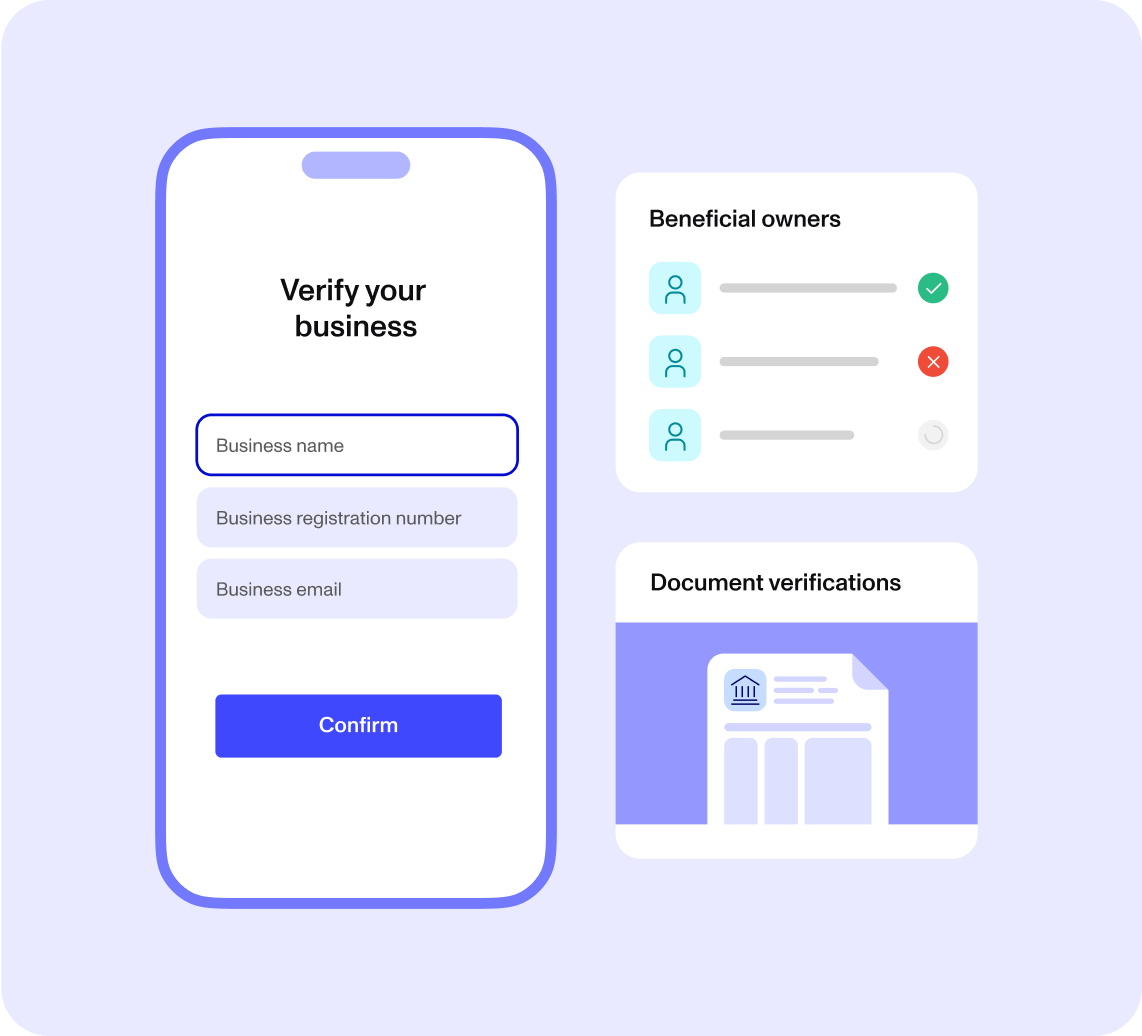
Collect core business details: Start with the basics — legal business name, registration number, business type, address, and proof of operational status. Many regulations, like the UK’s Economic Crime and Corporate Transparency Act, also require identity checks for directors and officers.
Verify beneficial ownership: Identify individuals who own or control 25% or more of the business. Then verify their identity using official documents, background checks, and identity verification tools. This step helps uncover hidden ownership structures that could signal fraud.
Cross-check information for consistency: Confirm that details like business name, address, registration ID, and financial records align across trusted sources, such as business registries, tax records, and sanctions lists. Mismatched data often indicates risk.
Monitor for changes over time: Businesses aren’t static. Use automated tools to flag changes in ownership, legal status, financial standing, or compliance issues. Ongoing monitoring keeps your records up-to-date and enables fast response to new risks.
Maintain detailed records: Log every verification step — what was checked, when, and what data source was used. Detailed, timestamped records ensure transparency for organizations.
Solutions like Persona help compliance teams put these steps into action with flexible, automated business verification flows. From validating business information to monitoring changes in real time, Persona’s platform gives you the tools to scale KYB, reduce fraud risk, and stay ahead of evolving regulations, without slowing down onboarding.
Learn more about Persona’s KYB solutions.
4 common challenges of business entity verification and how to overcome them
The cost of getting business verification wrong is rising fast. In Q2 2025 alone, global AML-related fines surged to $2.91 billion — a 193% jump from the previous quarter, according to Corlytics. Compliance teams know what’s at stake, but verifying businesses consistently and at scale isn’t easy. Data lives in silos. Regulations change. Beneficial ownership is often hidden. And when KYB processes rely on manual checks or fragmented tools, the risks multiply.
Here are four common challenges with business entity verification and how to overcome them:
1. Inconsistent records
Discrepancies between official registries, tax filings, and commercial databases can stall verification. Without standardized data, it’s hard to confirm legitimacy. Cross-checking information across multiple trusted sources — and using automated aggregation tools — helps reduce false positives and manual delays.
2. Global complexity and document variation
Going global introduces unique challenges, such as different regulatory frameworks, language barriers, and varied documentation formats. Using global data providers with local expertise supports accurate interpretation and helps align with jurisdiction-specific compliance requirements.
3. Manual review bottlenecks
Relying solely on manual checks leads to slower onboarding, higher error rates, and operational drag — especially at scale. Automating routine verification steps and flagging high-risk exceptions for human review keeps workflows efficient and compliant.
4. Lack of formal risk scoring
According to PwC, 42% of organizations either don’t have a third-party risk program or don’t perform risk scoring at all. This gap in oversight means that many businesses are engaging with vendors or partners without fully understanding their exposure. Without risk-tiering, teams can’t prioritize due diligence or allocate resources effectively.
Implementing progressive risk segmentation — automatically adjusting verification depth based on the risk profile — helps compliance leaders scale KYB without overburdening reviewers or slowing down good actors.
Streamline business entity verification with Persona’s flexible IDV solutions
Manual checks. Siloed tools. Fragmented workflows. Business entity verification doesn’t need to be this hard.
With Persona’s flexible IDV solutions, compliance teams can automate company verification end to end — bringing together identity verification, risk signals, and real-time monitoring in a single platform.
Here’s how Persona supports your business verification process at every stage:
Entity verification: Instantly validate business registration, ownership, and operational status using data from global business registries, tax databases, and other authoritative sources.
Beneficial ownership checks: Identify and verify individuals with significant control over the business, including multi-layered ownership structures.
Risk segmentation: Automatically adjust verification depth based on a business’s risk profile with Dynamic Flow — so you can scale without overburdening reviewers.
Status monitoring: Continuously monitor for changes in ownership, corporate structure, or compliance standing. Get alerted when a business needs re-verification or additional review.
Custom workflows: Tailor verification logic to meet internal KYB policies or jurisdiction-specific requirements with no-code, drag-and-drop automation.
Audit readiness: Maintain a fully searchable audit trail of every verification decision for simplified reporting and peace of mind.
Ready to simplify business verification? Contact us to see how Persona can help you prevent fraud, meet regulatory expectations, and onboard trustworthy businesses with speed and confidence.
The information provided is not intended to constitute legal advice; all information provided is for general informational purposes only and may not constitute the most up-to-date information. Any links to other third-party websites are only for the convenience of the reader.
FAQs
How can I verify a business is legitimate?
Toggle description visibility
To verify a business is legitimate, you need to confirm it’s real, authorized to operate, and not linked to fraud or financial crime. A modern, reliable business verification process includes:
Pulling official registration data from government and global business registries
Confirming beneficial ownership and verifying individuals with significant control
Checking licenses and regulatory filings to ensure operational legitimacy
Cross-referencing against sanctions, watchlists, and adverse media to flag high-risk entities
Monitoring for ongoing changes in ownership, compliance status, or business standing
Maintaining audit trails to prove decisions and stay prepared for reviews or investigations
Tools like Persona automate these steps — connecting directly to global data sources and screening workflows to keep verification fast, thorough, and fully documented. Learn more about our compliance solutions.
How do I verify LLC ownership?
Toggle description visibility
To verify the ownership of a limited liability company (LLC), you need to confirm who the members (owners) are and who holds significant control. This process is critical for compliance with regulations like the Corporate Transparency Act and for assessing business risk.
Here’s how to verify LLC ownership:
Check official business registration records: Use state-level databases in the US, such as a Secretary of State registry, to confirm the LLC’s legal status and listed members or managers.
Request and review the operating agreement: This internal document outlines ownership percentages, roles, and control rights among members.
Collect beneficial ownership information: Identify anyone with 25% or more ownership or who exercises significant control, in line with AML and KYB requirements.
Verify the identities of beneficial owners: Use trusted tools to screen for sanctions, watchlists, and other risk factors.
Maintain documented proof: Keep audit-ready records of the LLC ownership structure and verification steps.
With Persona, you can streamline this process using tools like Graph for ownership mapping, database checks for registration validation, and watchlist screening to assess risk.
What information is needed to verify a business?
Toggle description visibility
To verify a business, organizations need to collect and evaluate accurate, trustworthy business entity data. While requirements can vary by jurisdiction and use case, the core information typically includes:
Business registration details: Legal name, registration number, incorporation date, and jurisdiction
Ownership structure: Disclosure of beneficial owners and individuals with significant control (typically 25%+)
Contact and location details: A verifiable physical address, phone number, and business email
Licenses and certifications: Industry-specific permits confirming the entity is authorized to operate
Corporate documents: Articles of incorporation, operating agreements, and tax ID numbers (TIN/EIN)
Screening data: Results from watchlist, sanctions, and adverse media screenings for both the entity and its owners
What are business verification services?
Toggle description visibility
Business verification services are tools or platforms that help organizations confirm whether another business is real, legally registered, and trustworthy. These services automate checks that would otherwise be manual and error-prone, like pulling registration data, verifying beneficial owners, and screening against sanctions lists.
Modern business verification solutions and services go beyond static database lookups. They connect to global registries in real time, adapt to jurisdiction-specific regulations, and integrate seamlessly with internal workflows. With Persona, you can verify registration, ownership, licensing, and risk signals while keeping your process fully auditable.