
Making KYB feel like KYC with intelligent UBO verification


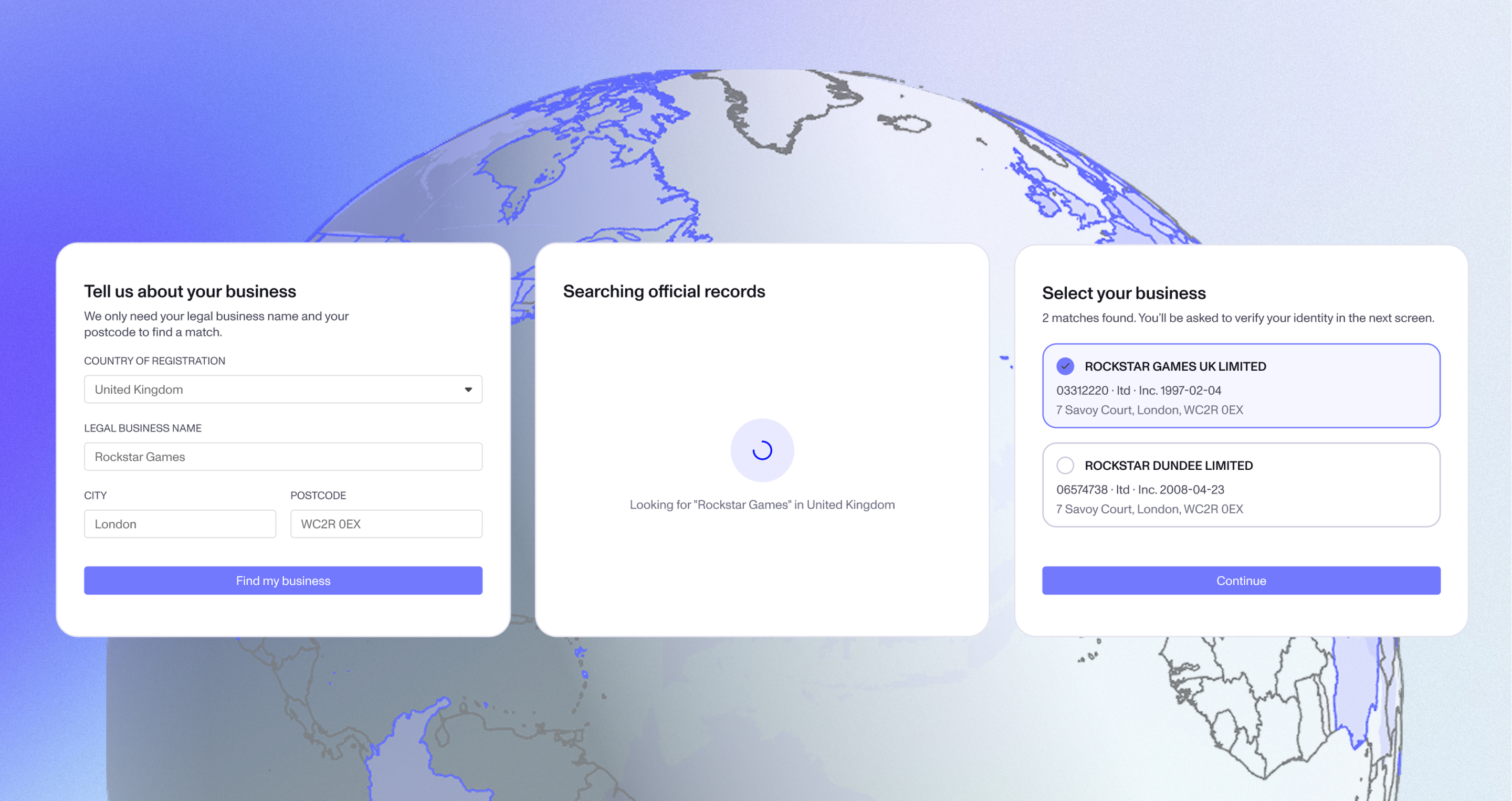


The highest compliment you can pay an identity flow is that nobody remembers going through it. Know Your Customer (KYC) has largely earned that. You open a link, the camera tells you when your ID is in focus, you take a selfie, and less than a minute later, you’re done.
Everyone remembers going through Know Your Business (KYB). The same person who verified in under a minute as an individual can spend a week and a half getting verified as a beneficial owner, and many never finish. McKinsey puts corporate onboarding at up to 100 days, with due diligence and account setup alone consuming more than 40% of that time.
There are specific reasons why KYB can feel daunting. In 2022, we addressed some of these when we launched the first integrated KYB-KYC flow. Today, we’re updating our KYB and ultimate beneficial owner (UBO) verification processes to make KYB even easier for everyone.
Why KYB feels like more of a burden than KYC
There are many reasons KYB requires more effort than KYC, and some of these are inherently tied to the requirements:
There is far more to verify: During KYC, an individual typically provides their name, a date of birth, and a document. For KYB, a business typically provides a legal entity name, a registration number, registered and physical addresses, the entity type, and tax identifiers.
There’s often less automation: KYC flows often automate data extraction and prefill forms. In the US, organizations can even autofill a user’s Social Security number (SSN) based on results from a third-party database. Business registry data is often available from issuing and authoritative databases, but many KYB flows still ask users to type it in.
The requests can be vague: KYB document requests are more expansive than KYC requests, and this sometimes leads to vague language. For example, if an application asks for “clear photos of your business documents,” it’s not actually clear if the organization wants copies of local, state, or regional paperwork.
It may require verifying beneficial owners: In addition to completing the verification requirements for the business entity, many applicants also need to provide information to verify the entity’s ultimate beneficial owners. Most founders can name their co-founders. Far fewer can quickly or easily trace ownership through a holding entity, calculate an indirect percentage, and judge whether it clears the local UBO threshold, which is now 25% under the new EU AMLR framework.
Manual reviews are still common: Many organizations receive contradictory information, such as an uploaded document naming three owners while the registry names two. An analyst typically has to review the data and sources, decide what to believe, work out the business’s structure, and confirm each part of the business is verified.
This is why business onboarding is often measured in days, and individual onboarding is measured in seconds.
Introducing a better experience with intelligent UBO verification
When we launched our international KYB solution in 2023, we focused on coverage. Being able to connect fintechs, marketplaces, and other customers to 150+ global data sources via a single integration offered meaningful time savings.
Data coverage has since become table stakes, and most credible KYB providers offer access to a wide set of business registries. The new question is, what can you do with all the information you receive from those registries?
This release focuses on making KYB feel like KYC with data prefills and owner-based verification. Persona can automatically route the people behind a business to the right verification for their role, while collecting evidence that can help your team review and resolve conflicting ownership records.
Prefill applications and improve completion rates with Business Search
We have new Business Search capabilities across the EU, Canada, the UK, and the US. Now, your applicant types a company name, Persona searches the proper issuing registry, and populates the entity details from the registry record. There will be roughly 80% fewer fields for an application to fill out during the initial business onboarding screen, which can greatly reduce how many applicants abandon the process.
Using data from registries can also remove false rejections due to typos. For instance, Companies House registration numbers are eight characters, and English and Welsh companies carry a leading zero. An applicant who types 1234567 instead of 01234567 can fail the match because of a single keystroke, but that won’t happen if the form is prefilled with the right number.
Prefilling means the number arrives in the format the registry uses, and a legitimate company stops getting rejected over a typo.
Programmatically find associated persons, UBOs, and legal representatives, and apply the appropriate verifications
Business onboarding applications often stall during UBO verification, especially when you rely on the applicant to collect identification documents from all the UBOs. Even a well-intentioned founder can spend weeks chasing down documents only to pass off unusable images.
Persona has direct access to data from registries in 28 countries and jurisdictions to identify UBOs on your behalf. Document AI can also extract ownership information and assess the authenticity of uploaded documents, including articles of incorporation, shareholder registers, certificates of incumbency, or local equivalents. If we’re not certain of the results, we can then ask the applicant to confirm or correct the UBO information.
From there, we verify each person with a risk-appropriate request to minimize friction. For example, a legal representative might complete a government ID check with a selfie plus proof of signing authority. An associated person might do just a government ID check with watchlist screening. A passive owner in a market with good registry data might be confirmed against an authoritative source and never contacted.
Go from conflicting ownership data to defensible decisions
Conflicting sources are common in KYB, and a registry record from last year might not reflect the ownership changes you see from a recent shareholder register. Someone on your team has to decide which source to use. Persona’s job is to make it easier to make a defensible decision.
In the Persona platform, your analysts open an ownership tree inside the case view, and each node shows where its information came from. When two sources disagree, you see both values side by side rather than having to spot the conflict yourself.
Case Review Agents can also do the first pass and handle routine reconciliation before escalating cases that require human judgment. Your reviewers, human or agentic, can also comment directly on the case, so the reasoning behind a decision is always next to the supporting evidence.
The cases and records remain available for future reviews. When you reverify the business next year, you can compare results against the previous decision rather than starting again. If there are new UBOs, they’ll show up as a change and get routed to the right verification automatically.
Make KYB feel like KYC with Persona
Every business that abandons an application due to a lengthy UBO verification step was motivated enough to begin. If you can remove some of the burden that’s often associated with KYB, you can increase completion rates and start your new business relationship off with a surprisingly delightful experience.
Intelligent UBO verification is generally available today, and we’ve automatically added the capabilities for customers who have integrated KYB-KYC flows on Persona. To see how it works in your flow, reach out to your account team or request a demo.
The information provided is not intended to constitute legal advice; all information provided is for general informational purposes only and may not constitute the most up-to-date information. Any links to other third-party websites are only for the convenience of the reader.
FAQs
What does UBO verification require?
Toggle description visibility
UBO verification means identifying the people who ultimately own or control a business, confirming they are who they claim to be, and assessing whether they are safe to do business with. It is a core requirement of many global anti-money laundering (AML) laws.
Why is UBO verification difficult?
Toggle description visibility
Three things can make UBO verification complicated:
- Ownership often runs through multiple entities: A German GmbH may be 40% owned by a Dutch entity that is 60% owned equally by two individuals in Portugal. Neither the German nor Dutch registry records tell you that each individual holds 12% of the German business.
- Owners and representatives have different relationships to the business. A legal representative signing on behalf of the entity might have obligations that a passive minority owner doesn’t.
- The source data can be contradictory. Business registries are often updated at different times and might not reflect current ownership details.