
How link analysis unravels identity mule rings



Identity verification helps prevent fraud by requiring would-be fraudsters to verify that they are real people and who they say they are. But what about a user who opens an account with their legitimate ID and selfie and then hands the keys to a bad actor?
That’s exactly what happens with identity muling, and this type of second-party fraud can be difficult to detect. Even a multi-layered defense that combines government ID, selfie, and database verifications could miss these soon-to-turn-bad accounts.
The secret to surfacing these accounts is to look for suspicious connections between accounts rather than focusing on the legitimacy of the individual users. And that’s exactly why link analysis is a critical part of many anti-fraud strategies.
What are identity mules?
Identity mules are people who willingly help a bad actor open an account by completing an identity verification request, usually in exchange for money. Identity muling typically takes one of these forms:
The mule opens an account using their real ID and selfie and then turns it over to the bad actor. The bad actors often guide the mule through the identity verification process.
The mule gives the bad actor images and recordings of their identifying documents and a selfie. Sometimes, these are collected from the mule when the mule creates an account. The bad actors inject the selfies into verification flows when opening accounts.
The bad actor creates a fake ID for the mule, who then uses it to open an account for the fraudster. The combination of a real selfie with fake (or stolen) information essentially creates a synthetic identity mule.
Fraudsters pay identity mules to open accounts because the accounts often appear legitimate during onboarding. These accounts can then be used to engage in many types of fraud, including:
Auction fraud (e.g., shill bidding, multiple bidding, shield bidding)
Marketplace fraud (e.g., fake profiles, buyer/seller closed-loop account)
Why link analysis is effective at surfacing identity mule rings
Link analysis can help you find and stop identity mule attacks by uncovering links between accounts rather than focusing on identity verification during onboarding. It’s a data science technique for understanding relationships and connections between data points.
Fraud fighters use it to find accounts or transactions linked by one or more attributes, such as a device fingerprint or a government ID number. Many link analysis tools, including Persona’s Graph, also have visual interfaces for investigators.
It’s normal for user accounts to occasionally share certain attributes. For example, multiple users share an IP address, physical address, or device if they live together. However, fraudsters also often reuse tactics and assets, such as images or devices, across attacks.
Link analysis can still be helpful because you can use it to find:
Accounts that were created on the same device or IP address
Selfies that look suspiciously similar, like they were taken in the same place
Groups of accounts that were created on different devices but share other connections
Connections that are multiple degrees or “hops” away
You can see how the identity mule rings operate
Consider an identity mule ring with a fraud ringleader or broker who pays mules to open accounts and hand over the login credentials. The fraudster shares the login information with their crew, who use a shared device to log in and monetize the accounts.
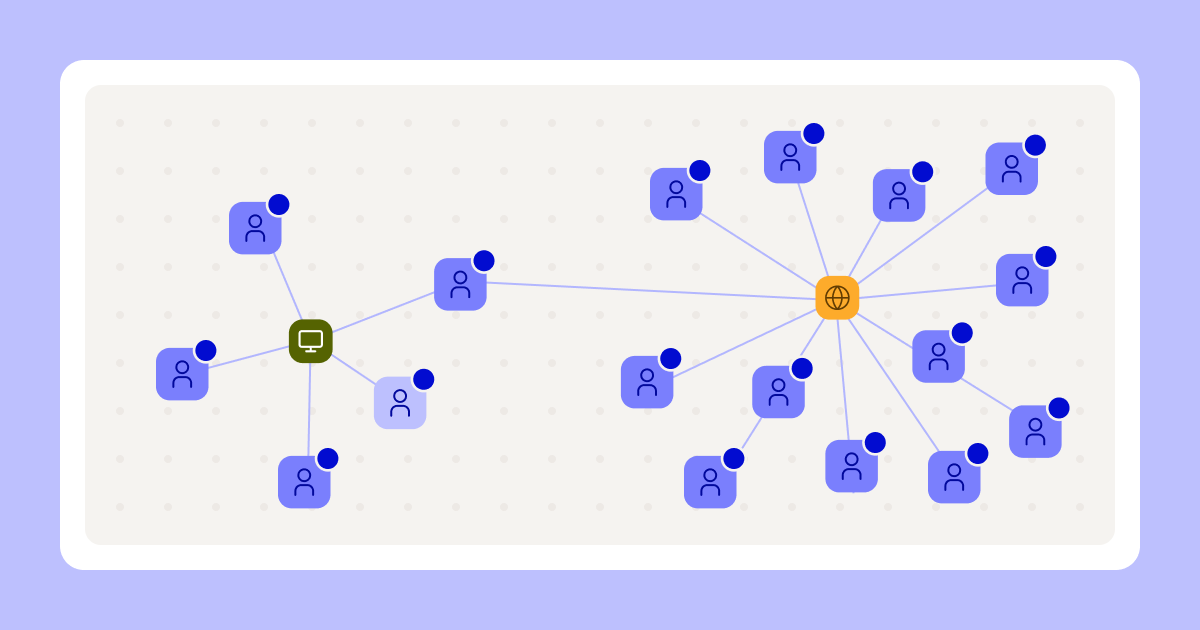
That’s likely what’s playing out in the image above, which is a real result from Persona’s Graph Explorer. The multi-hop search revealed that the group of accounts sharing an IP address (shown on the right) was connected to a group of people sharing a device (on the left).
You can spot identity mule rings even when the selfies are real
Similarly, consider a scenario where the fraudster is recruiting identity mules on the street. Or, if they have a steady stream of mules who complete verifications at the same house or office.
The mules open their accounts under a fraudster’s guidance. If the identity verification process includes government ID verification, then multiple mules may submit their IDs with similar backgrounds (e.g., a driver’s license placed on the exact same desk or countertop each time).
Likewise, if it includes selfie verification, then selfies submitted by mules in the same location may share similar backgrounds or lighting. A link analysis tool that includes image similarity nodes, like Persona’s Graph, can surface these similarities for further investigation.

Just one piece of the identity fraud puzzle
Link analysis is a powerful tool for surfacing different types of fraud, including identity mules, synthetic identities, and AI-driven fraud. But it’s important to remember that it’s just one layer of a broader anti-fraud strategy. That means it works best when deployed in conjunction with, not in place of, other tools and methods.
Interested in learning more about how link analysis and Persona’s Graph can help you fight fraud? Read eight ways one of our fraud analysts uses Graph each day, or reach out for a demo.
The information provided is not intended to constitute legal advice; all information provided is for general informational purposes only and may not constitute the most up-to-date information. Any links to other third-party websites are only for the convenience of the reader.